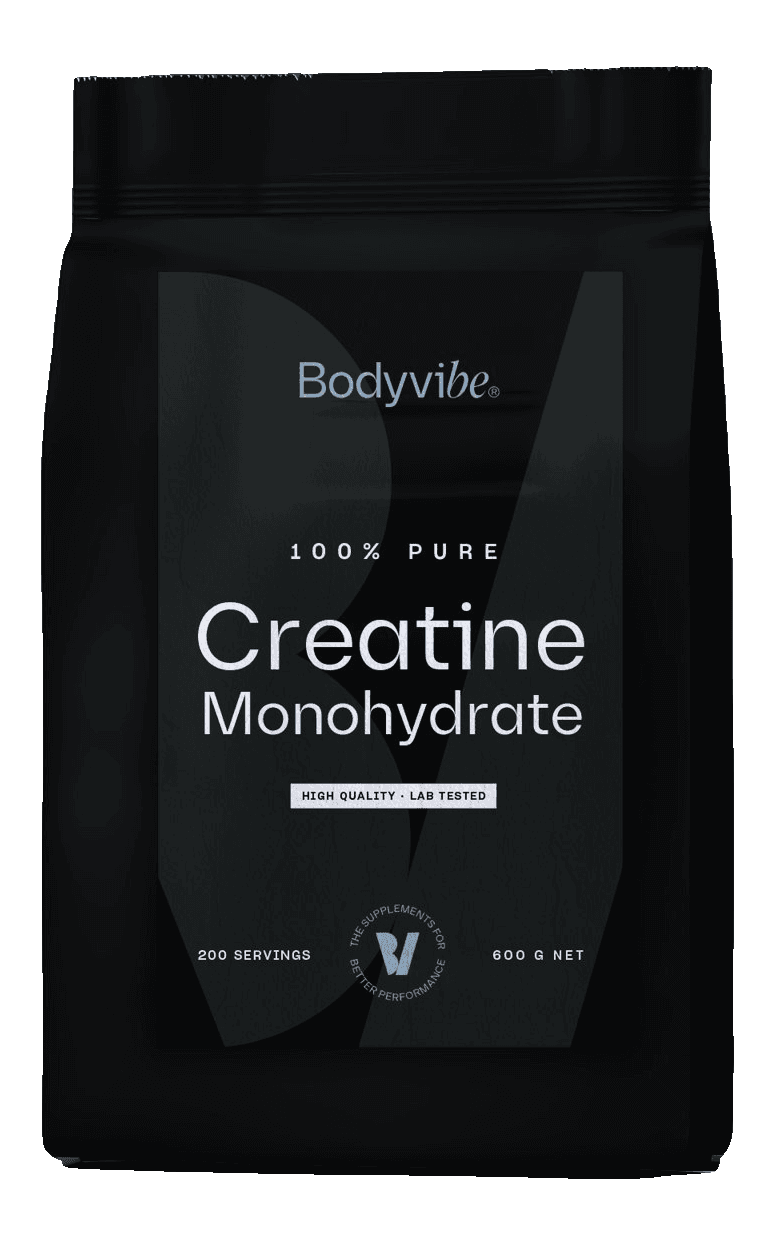
Creatine is one of the most studied ingredients in sports nutrition and, at the same time, one that gathers the most improvised protocols: loading phases, cycles, breaks, wash-out days. European regulation is far simpler. It sets a daily intake of 3 g as the condition of use for its authorised claim. This article explains where that figure comes from, what the claim actually says and how to read it on the label.
What creatine is
Creatine is a nitrogen-containing compound that the body forms from three amino acids (arginine, glycine and methionine) and that is also present in foods such as meat and fish. In food supplements, the most common form, and the one behind the authorised claim, is creatine monohydrate. Bodyvibe uses 100% micronised creatine monohydrate with a 200 mesh particle size: a fine powder that dissolves easily in water.
What the EU authorises
In the European Union, any sentence linking an ingredient to a function of the body must be authorised and listed in the EU register. For creatine there is one claim authorised by Regulation (EU) 432/2012, reproduced here word for word:
Notice two details. First, the claim refers to “successive bursts of short-term, high intensity exercise”, not to any sport or any goal. Second, the condition of use is not a guideline dose: it is the amount at which EFSA assessed the effect. That is why Bodyvibe declares 3 g per serving and no other figure.
Why no loading phase is needed
The “loading phase” (taking 20 g a day split into several servings for five to seven days, then dropping to a maintenance dose) is a popular gym protocol. It does not appear in the conditions of use and it is not needed to meet them: the authorised claim rests on a daily intake of 3 g, sustained over time. Taking more at the start is not part of what the regulation supports and adds nothing to the message Bodyvibe is allowed to communicate.
At 3 g a day, a 600 g pouch equals 200 servings: more than six months of continuous use. That is the arithmetic printed on the label and the one worth checking before buying any creatine: net weight divided by declared servings.
How to take it
- 3 g a day, measured with the scoop in the pouch or with a kitchen scale.
- Dissolved in water or any drink, at whatever time of day suits you.
- Every day, including days you do not train: the condition of use refers to daily intake, not training days.
- Adults only. If you are pregnant, breastfeeding, taking medication or have a medical condition, consult a health professional.
From the age of 55
A second authorised claim, added by Regulation (EU) 2017/672, targets a specific group: “Daily creatine consumption can enhance the effect of resistance training on muscle strength in adults over the age of 55”. Its conditions are strict: 3 g of creatine a day combined with resistance training at least three times a week, at 65–75% of one repetition maximum, for several weeks. Without that protocol the sentence cannot be used. Bodyvibe always reproduces it in full, with its conditions, and never shortens it.
What you will not read at Bodyvibe
Anything outside those two sentences and their conditions stays out of our copy: no other sporting goals, no effects on the mind, no promises about the day after training. We do not compare forms of creatine either: particle size (200 mesh) describes how the powder dissolves, nothing more. If you see such sentences on another product, they sit outside the EU register.
In short
- 3 g a day is the amount set in the conditions of use of the authorised claim.
- The regulation includes no loading phase: daily consistency.
- The claim targets adults performing high intensity exercise.
- The over-55 version requires resistance training and is always quoted in full.